
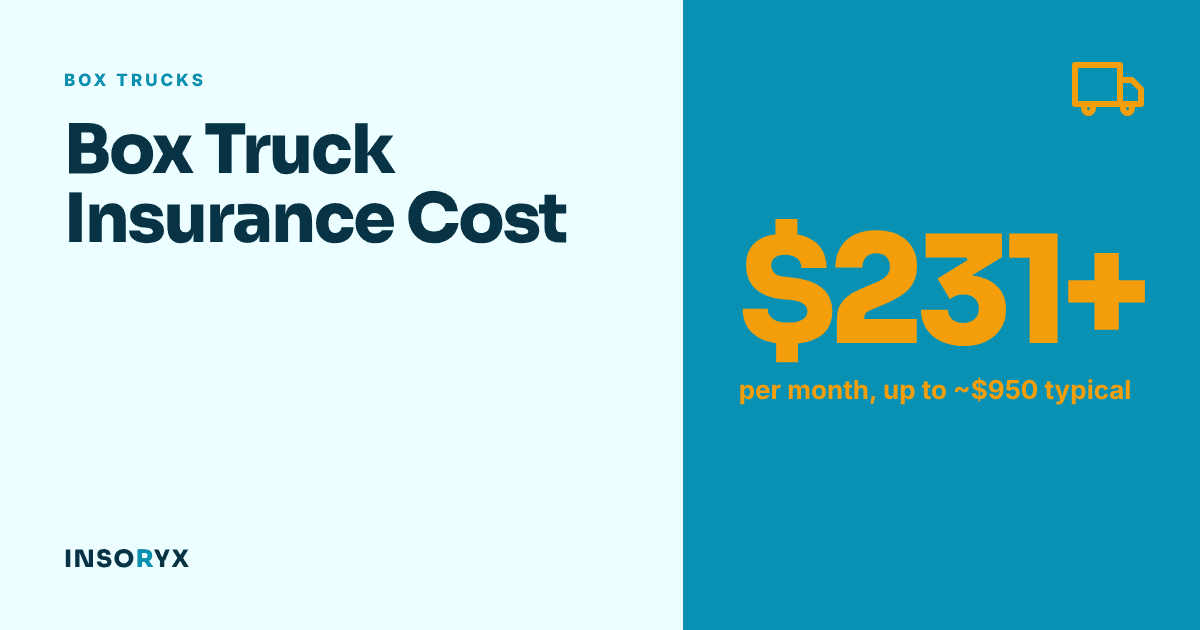
Most box truck operators pay $231–$950 a month ($2,772–$11,400 a year) in 2026. A 16-ft local delivery truck sits at the low end; a 26-ft truck runs $550–$1,100 a month for an experienced regional operator, and a brand-new 26-ft authority in a big city can pay $18,000–$31,000 a year.
- Typical box truck insurance: $231–$950/month.
- New-venture 26-ft trucks in urban areas: $18K–$31K/year.
- Reefer box trucks run about $700–$1,400/month.
- For-hire interstate needs $750K liability at 10,001+ lbs; most contracts want $1M + $100K cargo.
How much is box truck insurance by size and use?
| Profile | Monthly | Annual |
|---|---|---|
| 16-ft local delivery, owner-operator | $250–$600 | $3,000–$7,200 |
| 16-ft experienced, Indianapolis | $325–$525 | $3,900–$6,300 |
| 26-ft regional, owner-operator | $550–$1,100 | $6,600–$13,200 |
| 26-ft new venture, urban | $1,500–$2,600 | $18,000–$31,200 |
| Small fleet (3–5 trucks), per truck | $400–$800 | $4,800–$9,600 |
| 26-ft reefer / food | $700–$1,400 | $8,400–$16,800 |
| Hazmat box unit | $1,000–$2,000+ | $12,000–$24,000+ |
Figures compiled by FreightWaves for 2026. Estimate your own setup, including down payment and cost per mile, with the new authority truck insurance calculator.
Monthly cost, down payment and per-mile insurance cost for your truck and state.
What coverage does a box truck need?
- Auto liability — $750,000 federal minimum for for-hire interstate freight at 10,001+ lbs; $1M is the common contract ask
- Motor truck cargo — $100,000 is the usual broker or shipper minimum
- Physical damage — required on financed trucks; liftgates add value
- General liability — for loading docks, customer homes and moving work
- Workers' comp — required in most states once you hire helpers or drivers
What makes box truck insurance more expensive?
- New authority — the biggest factor in year one
- City routes — dense traffic means more claims (LA, NYC, Miami, Houston)
- Cargo type — food, electronics and hazmat cost more
- Driver records and CSA scores
- Gross vehicle weight and truck value
Do you need a CDL or MC number for a box truck?
Most 26-ft box trucks have a GVWR just under 26,001 lbs, so no CDL is needed — but a USDOT number is required for interstate commercial vehicles over 10,001 lbs, and for-hire carriers also need MC authority and insurance on file with FMCSA. Delivery contractors working under another company's authority may only need non-trucking or hired-auto coverage.
How to pay less for box truck insurance
- Start local or regional before going interstate
- Add telematics or dashcams — many carriers credit them
- Hire drivers with 3+ years of commercial experience
- Choose higher physical damage deductibles
- Bundle GL, auto and cargo with one specialist
- Re-quote at every renewal for the first three years
Frequently asked questions
About $550–$1,100 a month for an experienced regional owner-operator, and $1,500–$2,600 a month for a new venture in a large city.
Usually. Box trucks are lighter and often run shorter routes, so liability claims tend to be smaller than for tractor-trailers.
Yes, if you use it for business. Personal auto policies exclude commercial use and won't satisfy FMCSA or shipper requirements.
Commonly $1M auto liability and $100K cargo, plus general liability and workers' comp if you have employees. Check each program's current requirements.
No. Injuries to your helpers fall under workers' compensation, not your auto policy.
- FreightWaves — Box truck insurance cost (2026)
- FMCSA — Insurance filing requirements
- Insurify — 26-foot box truck insurance
Figures are typical ranges for education, not quotes. Insoryx is not an insurer or agency.