
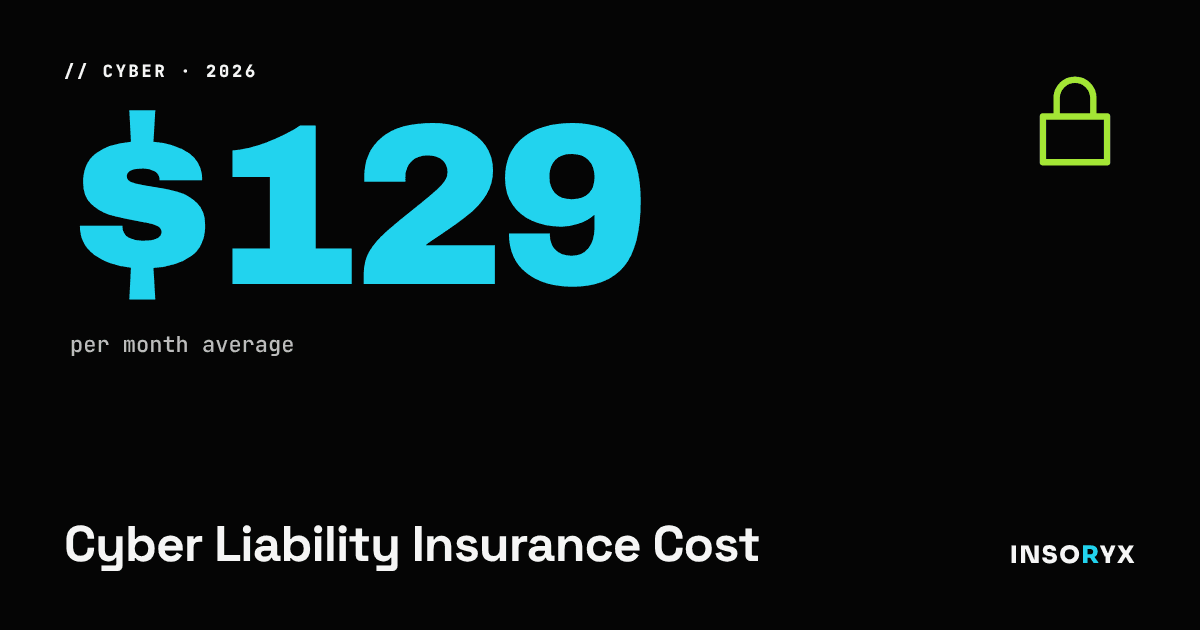
Cyber liability insurance costs about $129 per month, or $1,552 a year, on average for small businesses in 2026, according to Insureon. Annual premiums range from about $400 to over $8,000. Most policies carry $1 million to $5 million limits with a $1,000–$2,500 deductible, and the amount of sensitive data you hold is a major price driver.
- Small businesses pay about $129/month ($1,552/year) for cyber coverage.
- Premiums range from roughly $400 to $8,000+ a year.
- Typical limits are $1M–$5M; deductibles average $1,000–$2,500.
- MFA, backups and employee training can lower your rate.
What is the average cost of cyber insurance?
Insureon's 2026 data shows small businesses pay a median $129 per month ($1,552 per year) for cyber liability, with most premiums between $400 and $8,000+ a year.
What does cyber liability insurance cover?
| First-party (your losses) | Third-party (claims against you) |
|---|---|
| Breach response, forensics and notification | Lawsuits from customers whose data was exposed |
| Ransomware and extortion response | Regulatory fines and penalties where insurable |
| Business interruption from a cyberattack | PCI fines after a card data breach |
| Data restoration | Media liability for online content |
The free risk assessment flags cyber and the other gaps for your business type.
What affects the cost of cyber insurance?
- Amount and type of sensitive data — payment cards, health and Social Security numbers cost more
- Security controls — MFA, backups, endpoint protection, patching
- Industry — healthcare, finance and retail pay more
- Revenue and employee count
- Limits and deductible
- Claims history
Does my small business need cyber insurance?
If you take card payments, store customer records, use email for invoices or rely on cloud software to operate, yes. General liability and a BOP almost always exclude data breaches. Many client and vendor contracts now require cyber coverage too.
How to lower your cyber insurance premium
- Turn on multi-factor authentication for email, banking and remote access.
- Keep offline or immutable backups and test restores.
- Run phishing training at least annually.
- Patch systems and use endpoint protection.
- Choose a deductible you can absorb.
Frequently asked questions
Many small businesses start at $1 million. Businesses holding large volumes of sensitive data, or whose contracts require more, buy $2 million–$5 million.
Many policies cover ransomware response and extortion costs where legally permitted, subject to the policy's terms and sublimits.
Generally no. Some carriers offer a limited cyber endorsement, but a standalone cyber policy provides broader coverage and higher limits.
Insurers look at your industry, revenue, data volume, security controls such as MFA and backups, chosen limits and deductible, and prior incidents.
Figures are typical ranges for education, not quotes. Insoryx is not an insurer or agency.