
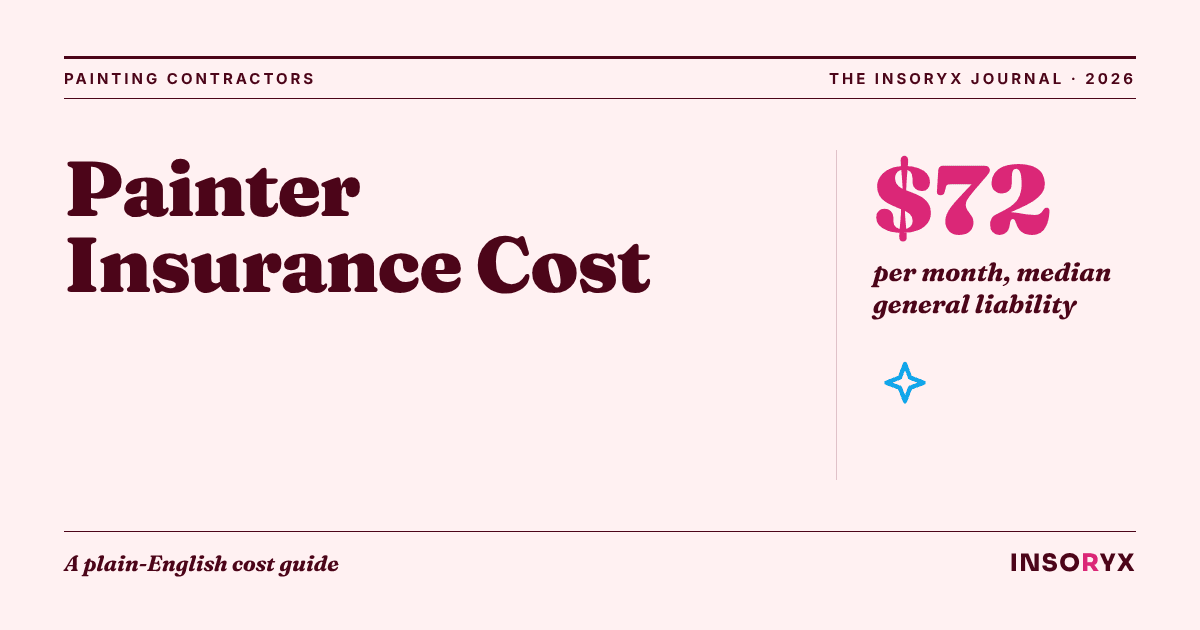
Painting contractors pay a median of about $72 a month ($862 a year) for general liability and $190 a month ($2,279 a year) for workers' comp, according to Insureon's 2026 data. A business owner's policy runs about $109 a month and commercial auto about $295. A solo painter with GL only can stay under $1,000 a year; a crew with comp and a van usually pays $5,000–$7,000.
- General liability: about $72/month — the most-requested certificate.
- Workers' comp: about $190/month; ladder falls make painting a high-rate class.
- Uninsured helpers can be charged to your policy at audit.
- Lead-safe (EPA RRP) certification is required for pre-1978 homes.
How much does painting contractor insurance cost?
| Policy | Monthly | Annual |
|---|---|---|
| General liability | $72 | $862 |
| Business owner's policy | $109 | $1,313 |
| Workers' compensation | $190 | $2,279 |
| Tools & equipment | $42 | $505 |
| Commercial auto | $295 | $3,539 |
| Professional liability | $67 | $808 |
| Commercial umbrella | $79 | $947 |
| Surety bond | $9 | $112 |
Insureon medians for painters, most with fewer than five employees. Exterior and commercial painting, high work and spray rigs push costs up; interior-only residential painters sit at the low end.
The helper trap: workers' comp for painters
Many painters pay helpers cash or on a 1099. If those helpers don't have their own coverage, your carrier can treat them as employees at audit and bill you for their payroll — sometimes years after the job. Read workers' comp for 1099 contractors and run your numbers with the uninsured subcontractor cost calculator.
See how much uninsured helpers could add to your workers' comp and GL audit bill.
What insurance do painters need?
- General liability — overspray on a neighbor's car, a spilled gallon on hardwood
- Workers' comp — required in most states once you hire
- Commercial auto — your work van or truck
- Tools & equipment — sprayers, ladders, scaffolding
- Pollution liability — lead paint and solvents are often excluded from GL
- License bond — required by some states and cities
How to lower painting insurance costs
- Bundle GL and property in a BOP
- Get certificates from every sub and helper
- Train crews on ladder safety and document it
- Separate interior and exterior payroll if your state allows
- Pay annually and raise deductibles on tools
Frequently asked questions
About $72 a month, or $862 a year, at the median for small painting businesses.
Most homeowners, property managers and GCs require general liability, and many states require workers' comp once you have employees. Some also require a license bond.
About $190 a month at the median, but it scales with payroll and your state's painting class rate.
Often not. Many policies exclude lead and pollution. Ask for contractor's pollution liability if you work on pre-1978 buildings.
Many states let sole proprietors exclude themselves, but GCs may still require a certificate or a waiver.
- Insureon — Painters insurance cost (2026)
- EPA — Renovation, Repair and Painting (RRP) program
- TechInsurance — Painter insurance cost
Figures are typical ranges for education, not quotes. Insoryx is not an insurer or agency.