
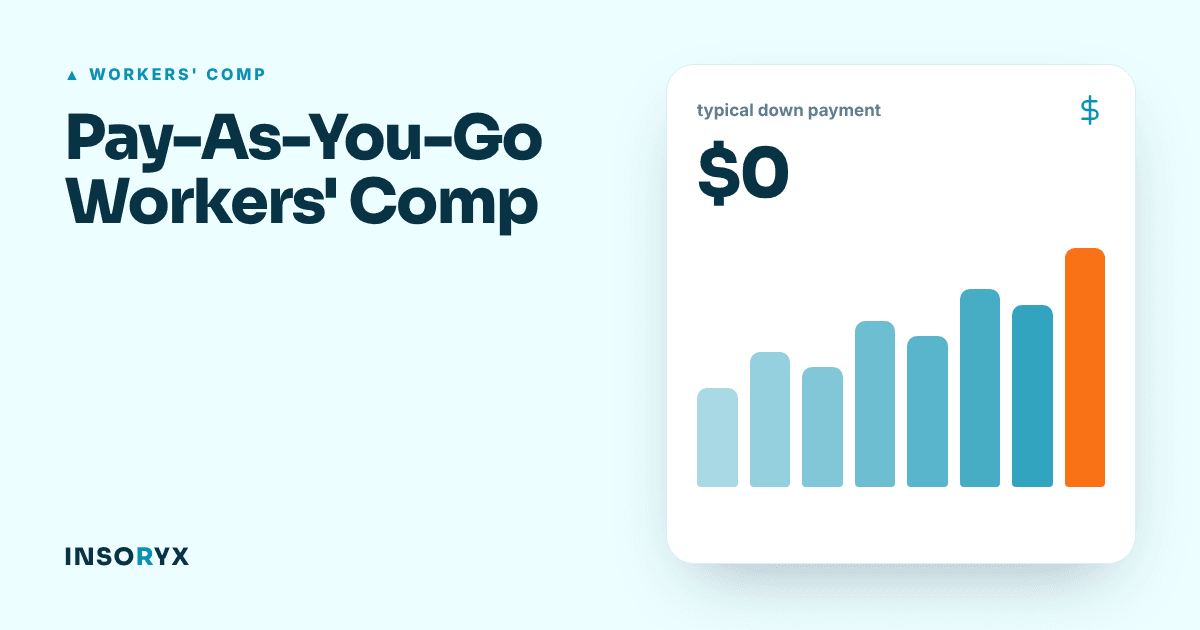
Pay-as-you-go workers' comp calculates your premium from actual payroll each pay period and collects it through your payroll provider, instead of charging an up-front deposit based on estimated payroll. It lowers the cash needed to start coverage and shrinks year-end audit bills, which makes it popular with seasonal, fast-growing and small businesses. Rates per $100 of payroll are the same — only the billing changes.
- Premium is billed each payroll run on actual wages.
- Little or no down payment compared with traditional policies.
- Audits still happen, but adjustments are usually much smaller.
- Requires a payroll provider that integrates with the insurer.
How does pay-as-you-go workers' comp work?
- You buy a workers' comp policy from a carrier that supports pay-as-you-go.
- Your payroll provider reports wages by class code each pay period.
- Premium = payroll ÷ 100 × your class rate, collected with each payroll run.
- At year end, the audit reconciles any differences — usually small.
| Traditional | Pay-as-you-go | |
|---|---|---|
| Down payment | Often 10%–25% of estimated premium | Little or none |
| Billing | Installments on estimated payroll | Each payroll run on actual payroll |
| Audit adjustment | Can be large | Usually small |
| Best for | Stable payroll | Seasonal or growing payroll |
Pros and cons of pay-as-you-go
Pros
- Better cash flow — no large deposit
- Fewer audit surprises as payroll changes
- Premium scales automatically with seasonal hiring
- Easier budgeting for small businesses
Cons
- Not every carrier or state offers it
- Requires a compatible payroll service
- Doesn't lower your rate — only changes timing
- Still need correct class codes and subcontractor COIs
Enter payroll and trade to see a typical premium range before you shop.
Who should use pay-as-you-go workers' comp?
Seasonal businesses (landscaping, roofing, holiday retail), contractors whose crew size changes job to job, startups hiring quickly, and any small business that was hit by a big workers' comp audit bill.
Is pay-as-you-go available in every state?
In most states, yes, through private carriers. In monopolistic state-fund states (North Dakota, Ohio, Washington, Wyoming), you buy through the state fund and its billing rules apply. Check your state's rules in workers' comp requirements by state.
Frequently asked questions
No. The rate per $100 of payroll is the same; you just pay as payroll runs instead of up front.
Yes, but because premium tracks actual payroll, adjustments are usually much smaller.
Yes. It's common for businesses with just a few employees, provided they use a compatible payroll provider.
Not automatically. Uninsured subcontractors can still be added to your payroll at audit — collect their certificates of insurance.
Figures are typical ranges for education, not quotes. Insoryx is not an insurer or agency.