
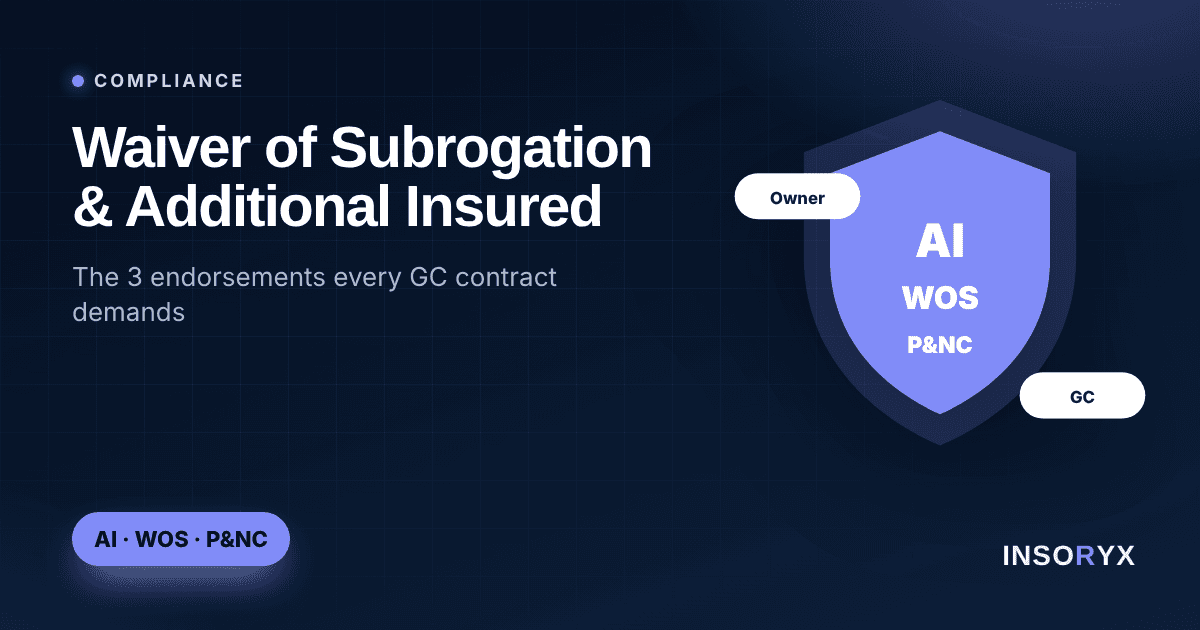
- Additional insured gives your client coverage under your policy for claims tied to your work.
- Waiver of subrogation stops your insurer from suing your client after paying your claim.
- Primary and non-contributory makes your policy pay first, without tapping the client's insurance.
- All three must be added by endorsement — typing them on a COI does nothing on its own.
The three endorsements at a glance
If you do commercial work, you'll see a sentence like this in nearly every contract: “Subcontractor shall name Owner and Contractor as additional insureds on a primary and non-contributory basis and provide a waiver of subrogation.” Here's what each piece means.
| Endorsement | What it does | Who it protects |
|---|---|---|
| Additional insured (AI) | Extends your policy's coverage to your client for claims arising from your work | The GC, owner or landlord |
| Waiver of subrogation (WOS) | Your insurer gives up its right to recover a paid claim from your client | The GC, owner or landlord |
| Primary & non-contributory (P&NC) | Your policy pays first and doesn't ask the client's policy to share | The client's own insurance record |
Additional insured: lending your policy to the client
When you name a client as an additional insured, they get the right to be defended and covered by your general liability policy — but usually only for claims that arise out of your work for them.
Example: a passer-by trips over your materials at a job site and sues both you and the GC. As an additional insured, the GC tenders the claim to your insurer instead of their own.
Scheduled vs blanket additional insured
A scheduled endorsement names a specific company. A blanket endorsement covers anyone you're required by written contract to name. If you work for many GCs, blanket wording saves days on every certificate request.
Waiver of subrogation: no lawsuits after the claim
Subrogation is your insurer's right, after paying a claim, to step into your shoes and sue whoever caused the loss to get its money back. A waiver of subrogation gives up that right against a named party.
Example: your employee is injured on a site because of the GC's scaffolding. Your workers' comp carrier pays the claim. Without a waiver, it could sue the GC to recover. With a waiver, it can't — which is exactly why the GC asks for it.
Contracts usually want waivers on three lines: general liability, commercial auto and workers' compensation. Some states restrict waivers on workers' comp, so check with a licensed agent where you work.
Paste the insurance clause and get every endorsement, limit and red flag explained — free, in about 30 seconds.
Primary and non-contributory: who pays first
When two policies could respond to the same claim, “other insurance” clauses decide who pays. Primary wording means your policy responds first. Non-contributory means your insurer won't ask the client's insurer to chip in.
For the client, that keeps claims — and premium increases — off their own record. For you, it's usually a no- or low-cost endorsement, but it must match the contract wording exactly.
What these endorsements cost
There's no single price — it depends on the carrier and how the endorsement is written:
| Endorsement | Typical pricing approach |
|---|---|
| Blanket additional insured | Often bundled in contractor GL packages; sometimes a flat annual fee |
| Scheduled additional insured | Per-name fee charged by some carriers |
| Waiver of subrogation — GL/auto | Often included in blanket form or a small flat fee |
| Waiver of subrogation — workers' comp | Commonly a percentage surcharge on the WC premium, or a flat fee per waiver |
| Primary & non-contributory | Frequently included with the AI endorsement |
The cheapest route is usually to put blanket versions on the policy at renewal, instead of paying per certificate all year.
Checklist before you sign the subcontract
- Paste the insurance clause into the Requirement Decoder and list every endorsement it asks for.
- Ask your agent which ones are already on your policy as blanket endorsements.
- Confirm additional insured covers completed operations if the contract says so.
- Confirm the waiver applies to GL, auto and workers' comp as required.
- Request the certificate of insurance with the endorsement numbers referenced in the description box.
Frequently asked questions
A waiver of subrogation is an agreement, added to your policy by endorsement, that your insurer will not sue the other party to recover money it paid on your claim. GCs and property owners require it so a covered loss doesn't turn into a lawsuit against them by your insurance company.
An additional insured is a person or company that gets coverage under your policy, usually only for claims arising from your work for them. A general contractor named as additional insured on a subcontractor's general liability policy can be defended by the sub's insurer if a third party sues over the sub's work.
Primary means your policy pays first for a covered claim involving the additional insured. Non-contributory means your insurer won't ask the additional insured's own policy to share the cost. Together they keep the client's own insurance, and their loss history, out of the claim.
Pricing varies by carrier. Some include blanket waivers in contractor packages at no charge; others charge a flat fee per certificate or a small percentage of premium, which is more common on workers' compensation. Ask your agent whether a blanket endorsement is cheaper than adding them one at a time.
No. Additional insured gives the other party coverage under your policy. Waiver of subrogation stops your insurer from suing them after it pays your claim. Contracts usually require both, plus primary and non-contributory wording.
- IRMI — additional insured and waiver of subrogation references
- Insurance Information Institute
- NAIC — consumer insurance resources
Figures are typical ranges for education, not quotes. Insoryx is not an insurer or agency.